MLA I Training Course Online
This ISO-compliant condition monitoring course provides foundational and advanced lubrication knowledge, equipping candidates to sit for the International Council of Machinery Lubrication (ICML) MLA I certification exam. Participants will gain insights into lubrication's critical role in machine reliability and learn best practices to optimize equipment performance and extend asset life.
Who is this course for?
- Lubrication technicians
- Maintenance & reliability professionals
- Fitters & mechanics with lubricant reponsibilities
- Operators
- Management that requires familiarisation
How is this course delivered?
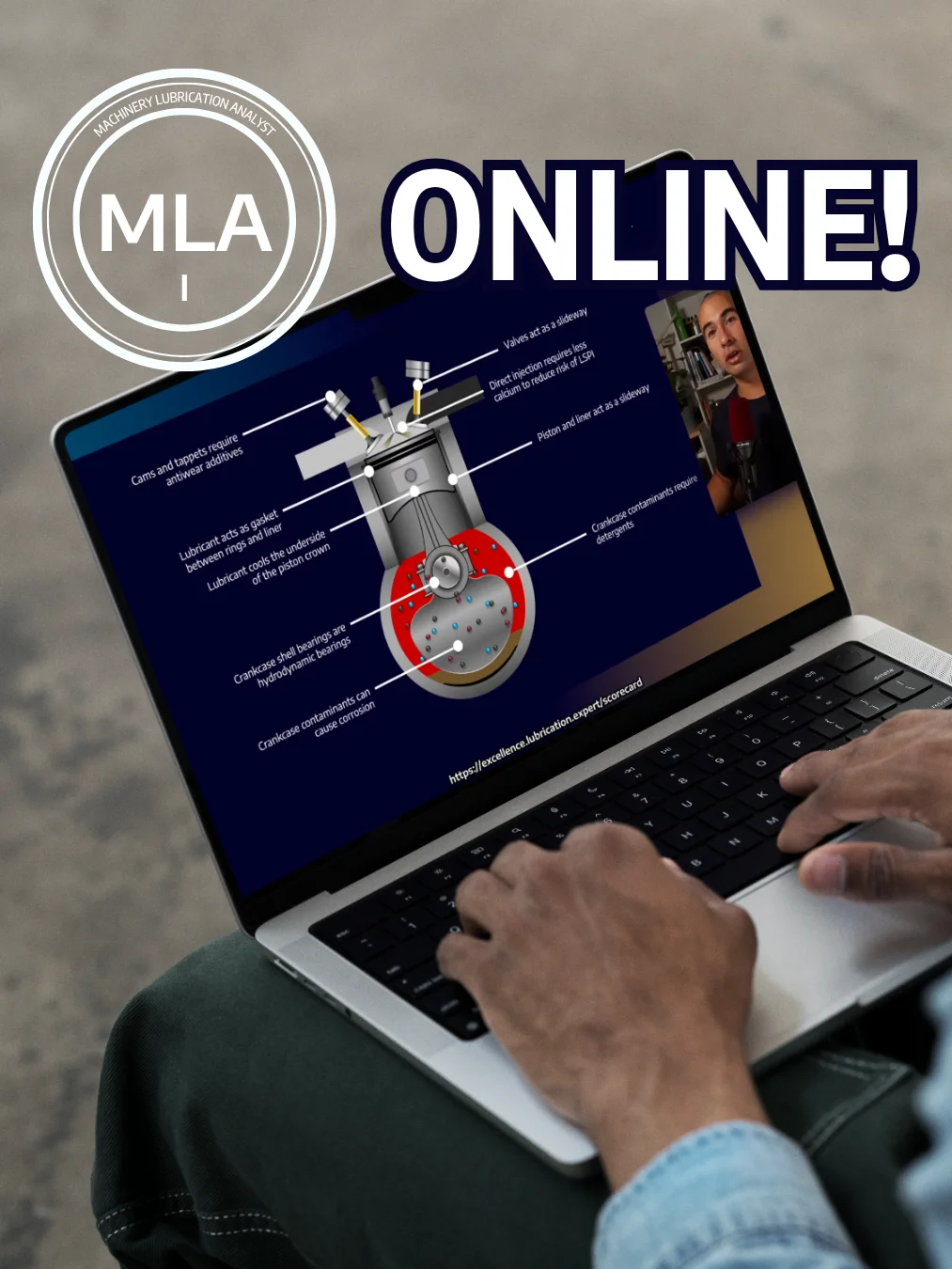
This training course is delivered in pre-recorded training videos, similar in style to the Lubrication Explained YouTube channel content. Scattered throughout, there are also quizzes at the end of each section to test your knowledge.
All course materials are contained within the Lubrication Explained Pro online training portal: https://learn.lubricationexplained.pro/
What do I gain access to?
- Digital video content covering the course requirements
- pdf of the course slides for revision purposes
- Practice questions
- 2x practice exams
How do I get certified?
Certification is completed by taking an exam through ICML. This can be conducted online, or through one of their public in-person exams held throughout the world. For more details, see https://www.icmlonline.com/apply2/
As part of the application process, you will be required to produce a course completion certificate. This is automatically issued to you in pdf form through the Lubrication Explained Pro training portal once you have completed the course materials.
Course Syllabus
Foundations of Lubrication
- The relationship between lubrication and machine reliability.
- Financial benefits of lubrication excellence.
- Four maintenance strategies and when to apply each.
- Six primary functions of lubricating oils and how friction is managed.
Lubricants: Properties and Selection
- Additives, base oils, and grease thickeners: composition, performance, and degradation.
- Seven key base oil properties and API categories.
- Choosing between synthetic and conventional oils.
- Proper selection of greases, base oils, and viscosity grades for various applications.
Application Methods and Challenges
- Best practices for oil and grease application, including centralized systems.
- Avoiding issues like over-greasing, aeration, and contamination.
- Grease and oil application methods for journal and rolling-element bearings, gearboxes, and motor bearings.
Lubrication for Specialized Equipment
- Selecting and maintaining lubricants for compressors, turbines, and hydraulic systems.
- Fire-resistant hydraulic fluids and synthetic lubricant applications.
- Guidelines for mobile and automotive equipment drive-line lubricants.
Contamination Control and Reliability Strategies
- Identifying and managing destructive contaminants like water, dirt, and varnish.
- Setting cleanliness standards and best practices for lubricant storage and handling.
- Techniques for effective oil sampling, analysis, and trend monitoring.
Oil Drains, Reservoir Management, and Storage
- Optimizing oil change intervals and implementing condition-based monitoring.
- Proper flushing and refilling procedures.
- Creating and maintaining a world-class lubricant storage system.
Lubrication Failure and Used Oil Analysis
- Recognizing signs of lubricant failure and degradation.
- Interpreting oil analysis data to set alarms and optimize equipment performance.
- Effective sampling techniques for hard-to-reach and pressurized systems.
Essential Field Inspections
- Simple, impactful visual and sensory inspections.
- Using filters, debris, and wear patterns as diagnostic tools.
Quality guarantee & returns
Hundreds of students have been through the MLA I programme with me and have successfully passed the MLA I exam through the International Council for Machinery Lubrication. The material is tried and tested, and we have no doubts that it will match your expectations of a quality training programme.
However, if there are issues encountered with the delivery of the product, whether it is an inability to access the materials from your country of origin or issues with site speed and loading times, please do not hesitate to get in contact with me at rafe@lubricationexplained.pro. We will endeavour to remedy the situation as quickly as possible. If no solution can be found, a full refund will be issued.